Wall Street and the Financial District in 2026: A Walking Guide to New York's Historic Heart
Narrow streets, soaring stone facades and the unmistakable energy of global finance. Wall Street may be one of the most powerful addresses in the world, but its story reaches far beyond the trading floor. Here, Dutch settlers laid out the streets of New Amsterdam, George Washington took his presidential oath and generations of New Yorkers built the foundations of a city that would become a global capital. Most visitors come for a photograph with the Charging Bull. Stay a little longer, and you'll discover one of Manhattan's most fascinating neighbourhoods.
TravelHubCam ·
 Watch the video
At the southern tip of Manhattan, New York changes character. The avenues give way to narrower streets, the buildings seem to rise almost vertically above you, and daylight filters between the towers in slender shafts. This is the Financial District, known to New Yorkers as FiDi — a neighbourhood where centuries of history meet the fast-moving world of modern finance.
Its most famous street, Wall Street, is synonymous with money, markets and economic power. The New York Stock Exchange stands among grand historic buildings, while glass towers reflect the changing light above streets that once belonged to a small Dutch settlement.
Yet the Financial District is more than a business address. It is one of the oldest parts of New York, filled with historic churches, Revolutionary-era landmarks, atmospheric cobblestone lanes and unexpected pockets of calm.
On weekdays, office workers and visitors fill the pavements. At weekends, the same streets can feel almost peaceful. Either way, FiDi rewards anyone willing to explore beyond the famous landmarks.
Give yourself a couple of hours, put on comfortable shoes and discover where New York's story began.
Where Is the Financial District?
The Financial District occupies the southern tip of Manhattan, roughly stretching from Chambers Street towards Battery Park, between the Hudson River and the East River.
At its centre is Wall Street, a short but internationally recognised street running between Broadway and the East River. Its name comes from a wooden defensive wall built by Dutch settlers in the 17th century, marking the northern boundary of New Amsterdam.
Today, the district is easy to explore on foot. Many of its best-known landmarks are only a few minutes apart, making it an ideal destination for a self-guided walking tour.
Getting there: Several subway stations serve the neighbourhood. Wall St (2/3 and 4/5 lines) and Broad St (J/Z) put you close to the heart of the district. Rector St and Whitehall St–South Ferry are convenient for the southern end near Battery Park.
 Live▶Wondering how Lower Manhattan looks right now?Watch the live webcam on LiveCity ↗
The Charging Bull and Fearless Girl
Two bronze sculptures have become some of the most recognisable sights in Lower Manhattan. One represents the confidence and ambition of the financial world; the other offers a very different message about determination and representation.
The Charging Bull
The imposing Charging Bull stands at Bowling Green, near the northern entrance to Battery Park. Created by Italian-American sculptor Arturo Di Modica, the bronze sculpture first appeared in 1989. The artist installed it without permission in front of the Stock Exchange as a symbol of optimism and resilience following the 1987 stock market crash.
The city subsequently moved the sculpture to its present location, where it became one of New York's most photographed landmarks.
Its powerful stance, lowered head and forward-charging posture make it an unmistakable symbol of Wall Street. Visitors often queue to photograph themselves beside it, and the area can become crowded throughout the day.
Fearless Girl
A few minutes' walk away, opposite the New York Stock Exchange on Broad Street, stands Fearless Girl.
The small bronze sculpture depicts a young girl standing confidently with her hands on her hips. When it was installed in 2017, it originally faced the Charging Bull. In 2018, it was moved to its current position in front of the Stock Exchange.
The contrast between the two sculptures has become an important part of the Financial District's modern identity. It is easy to visit both during the same walk.
Bowling Green
Just behind the Charging Bull is Bowling Green, a small enclosed park with a fountain and a history stretching back to the colonial period. Dating from 1733, it is often described as New York City's oldest public park.
After the crowds around the sculpture, this little green space offers a pleasant place to pause before continuing towards Wall Street or Battery Park.
Wall Street and the New York Stock Exchange
The New York Stock Exchange is perhaps the most recognisable building in the Financial District. Its monumental neoclassical facade, crowned by a row of six Corinthian columns and a large American flag, stands at the corner of Wall Street and Broad Street.
For generations, this has been one of the world's most important financial addresses. The building is a powerful architectural symbol of the markets and institutions that helped shape the modern economy.
Can visitors go inside? No. The Stock Exchange has been closed to the public since 2001, and there are no visitor tours of its trading floor. The best way to appreciate the building is from the surrounding streets, including the pedestrian areas protected by security barriers.
Even from outside, the scale of the architecture and the activity around the Exchange give you a sense of the district's importance.
 Watch the video
For a closer look at the neighbourhood before your visit, watch our Financial District walking video. It follows the streets and skyscrapers around Wall Street, offering a preview of the atmosphere of this remarkable corner of Manhattan.
Federal Hall: Where George Washington Took His Oath
Directly opposite the Stock Exchange stands Federal Hall, one of the most significant historic sites in American political history. A large bronze statue of George Washington stands on its steps, looking out towards the busy street.
On this site, on 30 April 1789, Washington took the oath of office as the first President of the United States. The original building served as the country's first seat of Congress, although it was later demolished. The present building was completed in 1842 and originally served as the Custom House.
Today, Federal Hall is managed by the National Park Service. It is usually open to visitors free of charge on weekdays, with exhibitions exploring the site's role in the early history of the United States. Opening arrangements can change, so check the official National Park Service website before visiting.
Trinity Church and Alexander Hamilton's Grave
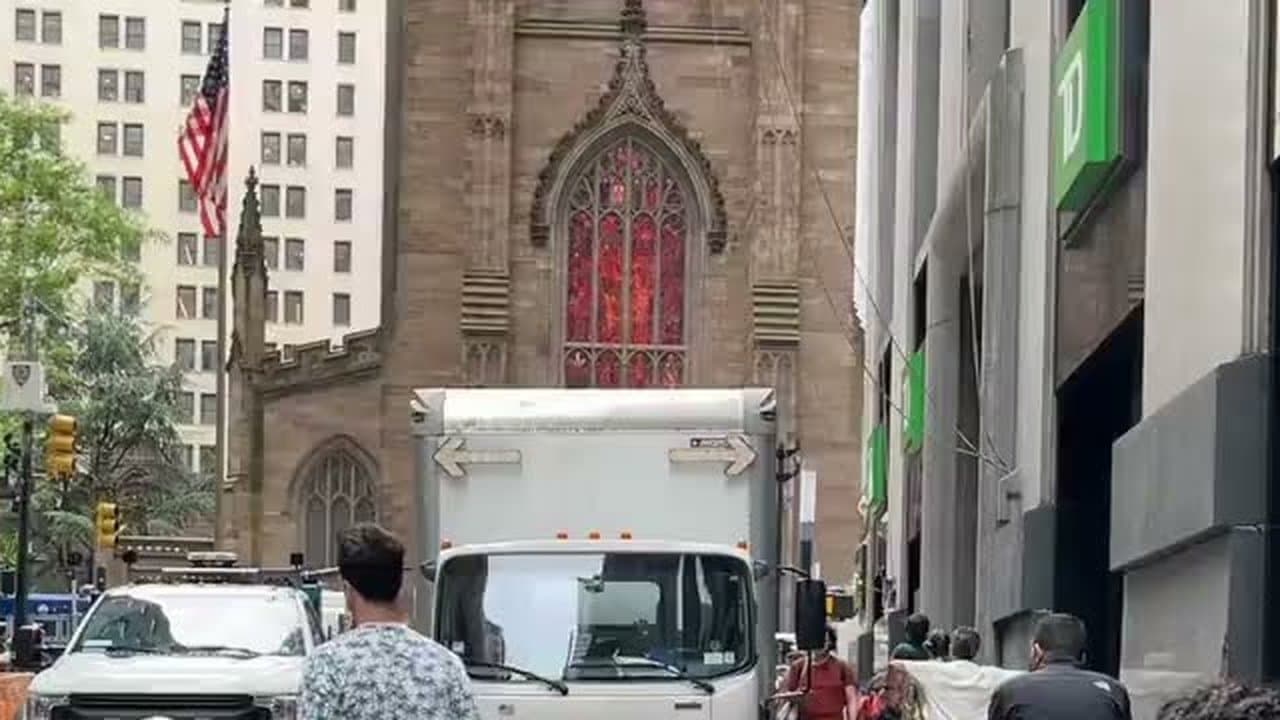
At the junction of Wall Street and Broadway, the Gothic Revival spire of Trinity Church rises between the surrounding skyscrapers. It was once the tallest structure in New York, and its historic silhouette remains one of the most striking architectural contrasts in Lower Manhattan.
Step through the gates and you enter a peaceful churchyard that feels far removed from the busy streets outside.
One of its most famous residents is Alexander Hamilton, the first Secretary of the Treasury and a central figure in the early history of the United States. His grave is here, beside that of his wife, Eliza Hamilton. Hamilton's story has reached a new generation through the hugely successful Broadway musical bearing his name.
The church and churchyard are generally open to visitors, although services and special events take place throughout the week. Be considerate of worshippers and anyone visiting to pay their respects.
Stone Street, Fraunces Tavern and Old New York
Beyond the monumental banks and office towers, the Financial District still preserves glimpses of an older New York. A short walk south of Wall Street brings you to narrow lanes, historic buildings and places that feel wonderfully different from the modern city.
Stone Street
Stone Street is one of the neighbourhood's most atmospheric corners. This short cobblestone lane is lined with historic brick buildings, restaurants and bars, creating a setting that feels almost European.
During warmer months, outdoor tables fill the street and the area becomes a popular destination for lunch, drinks and after-work gatherings. It is an especially appealing place to slow down after exploring the Financial District's major landmarks.
If you are looking for somewhere to take a break, Stone Street is an excellent choice.
Fraunces Tavern
At the corner of Pearl Street and Broad Street stands Fraunces Tavern, one of the historic buildings most closely associated with the American Revolution.
In December 1783, George Washington met his officers here to bid farewell at the end of the Revolutionary War. The event remains an important moment in the story of the young United States.
Today, the building houses a restaurant and the Fraunces Tavern Museum, where visitors can discover more about the Revolutionary era and the history of the city.
Delmonico's
On Beaver Street, the historic Delmonico's restaurant has been associated with the Financial District since the 19th century. It is often credited with helping popularise fine dining in America.
Even if you are not planning a meal, the building's distinctive curved corner entrance is worth noticing as you explore the surrounding streets.
When to Visit the Financial District
The neighbourhood changes character considerably depending on the day and time of your visit.
Weekdays bring the Financial District to life. Office workers fill the streets, lunchtime restaurants become busy and the area feels like a working centre of global finance. Federal Hall and many other attractions are also more likely to be open.
Weekends are generally quieter. The streets around Wall Street can feel surprisingly peaceful, making it easier to photograph the architecture and explore at your own pace. However, some cafés and restaurants catering mainly to office workers may be closed.
Early mornings are ideal for visiting the Charging Bull and photographing Wall Street without the largest crowds. The light between the tall buildings can also create beautiful contrasts of shadow and sun.
A Self-Guided Walking Route Through the Financial District
The main sights are close together, so you can explore the heart of the Financial District in approximately one to two hours, depending on how long you stop at each landmark.
Here is a convenient route:
- Bowling Green and the Charging Bull — Begin at the southern end of Broadway, where the famous bronze sculpture attracts visitors throughout the day.
- Broadway and Trinity Church — Walk north towards the churchyard and discover the grave of Alexander Hamilton.
- Wall Street — Turn east and follow the historic street through the heart of the financial district.
- Federal Hall and the Stock Exchange — Admire the monumental facades and the statue of George Washington.
- Fearless Girl — Continue to Broad Street, where the sculpture stands opposite the Stock Exchange.
- Fraunces Tavern and Stone Street — Finish among the cobblestones, historic buildings and restaurants.
From Stone Street, it is only a short walk back towards Battery Park, where ferries depart for the Statue of Liberty and Ellis Island.
If you are planning to continue across the harbour, read our guide on how to visit the Statue of Liberty before you go.
Combine Your Visit with the Rest of Lower Manhattan
The Financial District is ideally positioned for a wider exploration of Lower Manhattan. You can easily combine its historic landmarks with some of New York's most important modern sights.
To the north, the World Trade Center complex brings together striking contemporary architecture, the 9/11 Memorial and the spectacular white structure of the [Oculus](/walk/new-york-oculus-and-one-world-trade-centre-walk-manhattan-new-york-city-no-talking-walk). Our guide to visiting the 9/11 Memorial & Museum explains how to plan your visit, including tickets, opening hours and what to expect inside.
For a longer walk, follow our Lower Manhattan self-guided walking route, connecting the Oculus, the Financial District, Tribeca and the Brooklyn Bridge.
And if you want to finish the day with one of New York's most memorable walks, continue across the East River with our guide to walking the Brooklyn Bridge.
See Lower Manhattan Live
Before heading out, take a look at the neighbourhood from another perspective.
Our World Trade Center skyline live webcam on LiveCity offers a real-time view of Lower Manhattan. Check the weather and changing light over the skyline, and get a feel for the city before you arrive.
It is a simple way to bring the streets of New York a little closer, wherever you happen to be.
Financial District: Essential Visitor Information
| Detail | Information |
|---|---|
| Location | Southern tip of Manhattan, around Wall Street and Broad Street |
| Subway | Wall St, Broad St, Rector St, Whitehall St–South Ferry |
| Admission | Streets and sculptures free; Federal Hall usually free |
| Stock Exchange | Closed to the public; no tours |
| Charging Bull | Bowling Green; arrive before 08:00 to avoid crowds |
| Time needed | 1–2 hours for the main sights |
| Best time | Weekday mornings for atmosphere; weekends for photographs |
| Where to eat | Stone Street, Fraunces Tavern, Delmonico's |
| Combine with | Statue of Liberty, 9/11 Memorial, Brooklyn Bridge |
Where New York Began
Most visitors arrive in the Financial District looking for a photograph with the Charging Bull. But the real pleasure of this neighbourhood comes from staying a little longer.
Here, the wooden wall that gave Wall Street its name belongs to the same story as the grand columns of the Stock Exchange. Washington's inauguration took place just steps from the offices of modern finance. Alexander Hamilton rests in a quiet churchyard beneath a skyline that would have been unimaginable in his lifetime.
Walk slowly. Look up at the architecture. Step into Trinity Churchyard, pause on the steps of Federal Hall and let the cobblestones of Stone Street lead you towards a well-earned break.
Then continue south to Battery Park, where the streets open onto the harbour and the Statue of Liberty appears on the horizon.
Plan your walk through Wall Street and the Financial District, explore the neighbourhood through our walking video and check Lower Manhattan live on LiveCity before you go.